
Returns used to feel like a back-office headache you dealt with after the sale. In 2026, that mindset gets expensive fast. Return volume is rising, with Forbese estimating they will cost retailers more than $685 billion, and shipping costs aren’t easing up, either. Today’s consumers have been trained to expect self-service convenience with fast resolution and clear updates. If your returns workflow is still stitched together with spreadsheets, inboxes, and manual label creation, it won’t just slow the warehouse down. It can spill into conversion rate, customer lifetime value, support ticket volume, and fraud exposure.
At ReadyCloud, we view returns as part of the post-purchase journey, not as a separate system you deal with once orders ship. That’s the shift happening across ecommerce right now, and it’s reinforced by industry data and operational benchmarks that sellers are using to plan. The opportunity is real: the same returns activity that drains margin can also produce the clearest signals you’ll get about product quality, merchandising gaps, and customer expectations.

“The post-purchase experience deserves a seat at the executive table because it affects both brand equity and margin. A better return process can reduce service volume while increasing customer confidence. Clearer shipping communication can lower inbound tickets while improving trust. Faster resolution can protect repeat purchases. Cleaner workflows can reduce stress on teams and make the business easier to scale.” Read Article on Forbes

The 2026 Returns Landscape: The Numbers Driving New Decisions
Returns are a massive economic force, broader retail projections have put total returns in the neighborhood of $850 billion for 2026. That’s the environment sellers are carrying into 2026 planning, with reverse logistics becoming more visible in boardroom conversations, not only warehouse standups.
Ecommerce teams feel the pressure first because online return rates tend to be higher than those in overall retail. Benchmarks cited in recent industry reporting put overall return rates around the mid-teens, while ecommerce return rates hover closer to the high teens. Even if your brand beats the average, a single peak season can expose the weak points in your process, especially if customer service and warehouse teams are working from different data sources.
Peak season is a clear example of how quickly this can intensify. Adobe Analytics reported that U.S. online shoppers spent $257.8 billion from November 1 through December 31, 2025, up 6.8% year-over-year. Sales growth like that often looks great on the surface, yet it also sets up a larger wave of returns that arrives a week or two later and lingers well into January. If you’re staffed and tooled for last year’s returns volume, you can end up behind even in a “good” season.
Shipping costs are another driver that makes the returns strategy feel urgent in 2026. USPS announced an early 2026 rate increase of around 6.6% across popular Priority Mail services and other offerings. Every label becomes more expensive, which changes the math on return routing, label coverage, and exchanges versus refunds. A product returns workflow that reduces unnecessary labels and speeds disposition is worth more today than it was even a year ago.
Shoppers want clear explanations and real-time updates before they have to ask. The return portal experience isn’t a “nice-to-have” anymore. It’s a trust mechanism that can reduce anxiety, lower support costs, and keep customers from defecting after a frustrating resolution.
Policy behavior adds a layer of complexity. Many shoppers read return policies before they buy, and free returns still influence purchase decisions for a large share of customers. At the same time, retailers have tightened policies, shortened windows, and added return fees in more cases.
There’s a real push-and-pull here: policy restrictions can reduce certain types of returns, yet they can also increase cart abandonment, something that’s estimated to cost retailers $4 trillion per year, or drive customers to competitors. The brands performing well aren’t guessing. They’re using returns data to shape policies that protect margin while keeping the experience clear and consistent.
Return fraud is also part of the 2026 reality, not an edge case. Industry reporting cited in the doc pegs return fraud at a meaningful percentage of overall return volume, plus survey data suggests many shoppers think bending the rules is acceptable. That combination forces brands to add checks, yet the wrong checks punish good customers and spike support tickets. A modern returns approach needs smart, segment-aware guardrails that are consistently applied.
| 2026 Returns Factor | What It Means for Retailers | Why It Matters |
|---|---|---|
| Returns are a major economic force | Total retail returns are projected to reach roughly $850 billion in 2026. | Reverse logistics is now a boardroom issue, not just a warehouse concern. |
| Ecommerce return rates remain higher | Overall retail return rates sit around the mid-teens, while ecommerce rates trend closer to the high teens. | Even efficient brands can feel the strain during peak season if service and warehouse teams use disconnected data. |
| Peak season creates a delayed returns wave | U.S. online shoppers spent $257.8 billion from November 1 through December 31, 2025, up 6.8% year over year. | Higher holiday sales often lead to heavier return volume in late December and January. |
| Shipping costs are rising | USPS announced an early 2026 rate increase of about 6.6% across popular Priority Mail services and other offerings. | Every return label costs more, making smarter routing, exchanges, and label control more valuable. |
| Customers expect visibility | Shoppers want clear return instructions and real-time updates before contacting support. | A strong return portal builds trust, reduces anxiety, lowers support volume, and improves retention. |
| Return policies influence buying behavior | Many shoppers read policies before purchasing, and free returns still affect buying decisions. | Strict policies may reduce some returns, but they can also increase cart abandonment or push customers to competitors. |
| Data-driven policies protect margin | Retailers are tightening windows, adding fees, and refining rules more often. | The strongest brands use returns data to balance margin protection with a clear, consistent customer experience. |
| Return fraud is a growing concern | Return fraud represents a meaningful share of return volume, while some shoppers view rule-bending as acceptable. | Brands need smart, segment-aware guardrails that reduce abuse without frustrating honest customers. |
“Your returns policy is actually one of the more influential pages on your website. Research from this UPS Survey finds that as many as 81% of consumers will read your return policy before making a purchase decision.” Read Full Article on Forbes

The True Cost Of Returns: Where Margin Disappears
The refund amount is the most visible cost of a return. It’s also the least helpful number to use when managing returns strategically. The real cost of a return includes the label, labor, clock time, resale recovery, and the support burden it creates. Once you account for all that, it becomes clear why even a small reduction in avoidable returns can produce outsized savings.
Here’s the practical cost model we recommend using as your baseline, because it maps directly to how returns impact operations in real life. It also makes ROI conversations more accurate, since it avoids the trap of measuring “refund dollars” as if that’s the whole story.
- Shipping costs include inbound return shipping and any outbound movement tied to recovery or exchange shipments.
- Processing labor includes receiving, inspecting, grading, repackaging, and restocking time.
- Value loss includes markdowns, refurbishment, disposal, and liquidation impact on product value.
- Support overhead includes tickets, chats, calls, and inquiries about refund status tied to returns.
Inbound return shipping plus outbound movement for recovery or exchanges.
Receiving, inspecting, grading, repackaging, and restocking work.
Markdowns, refurbishment, disposal, and liquidation impact.
Tickets, chats, calls, and refund-status inquiries tied to returns.
Each one of these lines compounds during peak. If the team is behind, the value loss often gets worse, since delayed restocks can force markdowns or missed selling windows. That’s why “time” is such a key dimension of return cost. Time to resolution, warehouse cycle time, and time to restock all have direct margin consequences.
Support overhead is also more expensive than many teams expect. A sluggish return flow tends to generate “where’s my refund” contacts, repeated follow-ups, and manual escalations. Those interactions cost money, but they also pull focus from revenue-driving work and slow teams down during the exact weeks when they’re already overloaded. A smoother self-service experience with proactive updates not only helps the customer. It protects the support team’s capacity.
The most important takeaway is that returns aren’t only a warehouse issue. They’re a cross-functional system that touches conversion, loyalty, support, finance, and fraud. Treating returns as infrastructure changes what you invest in and what you measure.
“Returns are devastating retailers. In 2024, it was estimated that returns amounted to over $685 billion in lost revenue in the U.S. alone. That’s not just a logistics problem; it’s a significant business challenge.
As the director of sales & strategic partnerships for a company that makes a popular e-commerce returns software solution, I often talk with e-commerce leaders. And one thing I’ve noticed is that some treat returns as an afterthought, something to handle only when it becomes unmanageable. But the most successful brands I’ve worked with view returns differently. They don’t just absorb the cost; they use returns to inform better decisions, boost customer retention and open new doors for growth.” Read Full Article on Forbes
What Modern Returns Software Should Handle End-to-End
If your current returns process feels like a patchwork of apps and manual steps, you’re not alone. Many brands have label tools, a help desk, a warehouse system, and a payments stack, yet none of them are orchestrated around returns as a workflow. That’s where a dedicated returns system earns its keep: it ties the lifecycle together so that customers and internal teams operate from the same source of truth.
A complete workflow should cover returns from initiation to final disposition, without forcing your teams to re-enter data across tools. The goal is fewer manual touches, fewer exceptions, and faster resolution, with clear visibility for both the shopper and the operator.
A modern system should handle:
- Return initiation that’s branded and self-serve, with clear steps and plain-language policy reminders.
- Eligibility checks that enforce your rules consistently, including window length, condition requirements, final sale rules, and category exceptions.
- Label creation options that align with your strategy, including automated workflows that reduce unnecessary shipping where appropriate.
- Real-time tracking and status updates that keep customers informed without needing to contact support.
- Receiving workflows that standardize inspection, grading, and condition notes so the warehouse isn’t reinventing decisions per item.
- Disposition rules that guide what happens next, including restock, refurbish, route to a specific location, or move into a resale channel.
- Resolution paths that support exchanges and store credit, not only refunds, so you can retain value where it makes sense.
- Reporting that ties return reasons back to products, customers, and time periods, so return data turns into decisions.
“E-commerce is as popular as ever before, and the return rates that come with it are growing fast. During the post-holiday period, these figures can spike. Vogue reported that, in December 2024–January 2025, consumers globally sent back $112 billion in merchandise—up 30% compared to the year before.
Every return eats into margins. There’s the cost of shipping, handling, restocking and, in many cases, refunding without recovery. Multiply that across tens of thousands of orders, and the impact is clear: Returns are no longer just an operational inconvenience but a vulnerability. The brands still relying on legacy systems, manual processes or disconnected teams will feel it first.” Read Full Article on Forbes
Modern Returns Workflow
A clear, connected system that keeps customers informed and operations aligned
Return Initiation
Branded, self-serve experience with simple steps and clear policy guidance.
Eligibility Checks
Consistent rule enforcement across return windows, condition, final sale, and category limits.
Label Strategy
Flexible label creation with automation that reduces unnecessary shipping.
Tracking Updates
Real-time status visibility that keeps customers informed without support tickets.
Receiving Workflow
Standardized inspection, grading, and condition notes for consistent decisions.
Disposition Rules
Clear next steps including restock, refurbish, routing, or resale channel placement.
Resolution Paths
Support for exchanges and store credit alongside refunds to retain value.
Reporting Insights
Connect return reasons to products, customers, and timeframes for smarter decisions.
Shopper expectations are a major reason this matters. Customers want acknowledgement, clear explanations, and real-time updates before they have to ask. If your return experience doesn’t provide that visibility, you’re training customers to open tickets and chase support, which increases cost per return and increases frustration at the same time.
This is also where returns become brand-defining. Customers don’t judge your operations chart. They judge whether the experience feels fair, fast, and predictable. The same policy can feel customer-friendly or customer-hostile based on how clearly it’s communicated and how smoothly the portal and updates work.
The Operational KPIs Top Teams Track In 2026
A lot of brands track return rate and stop there. It’s a starting point, not a system. In 2026, the teams making progress tend to treat returns like a performance channel, with inputs, outcomes, and segmented patterns. That means measuring the lifecycle, not only the volume.
- Return rate by category and SKU family to spot product-level patterns and shifts.
- Return reasons using standardized reason codes to ensure trends remain consistent and comparable over time.
- The exchange rate and store credit selection rate to measure how often the value is retained instead of refunded.
- Time to resolution from return initiation to completed refund or shipped exchange.
- Cost per return, including shipping, labor, processing, and loss in item value.
- Warehouse cycle time from item receipt through final disposition.
- Support contacts per return to find friction points and portal gaps.
- Fraud indicators such as high-frequency returners and unusual condition patterns.
Returns Performance Metrics That Matter
The data points that reveal where your returns process is working and where it needs attention
Return Rate by Category
Track return trends across product types and SKU families to identify patterns and shifts.
Return Reasons
Use standardized reason codes so trends stay consistent and comparable over time.
Exchange and Credit Rate
Measure how often customers choose exchanges or store credit instead of refunds.
Time to Resolution
Monitor the full timeline from return initiation to refund completion or exchange shipment.
Cost per Return
Account for shipping, labor, processing, and product value loss in each return.
Warehouse Cycle Time
Measure how long it takes from item receipt to final disposition in the warehouse.
Support Contacts per Return
Identify friction points by tracking how often customers reach out during the return process.
Fraud Indicators
Watch for high-frequency returners and unusual condition patterns that suggest abuse.
Segmentation is where the data becomes truly useful. A first-time shopper returning a low-cost item is different from a long-term customer making a rare return on a high-value purchase. Treating those scenarios the same is how brands lose both money and goodwill. A stronger approach applies guardrails and incentives based on customer history, category risk, and operational cost, while keeping the experience smooth for legitimate shoppers.
This is also where return data becomes a growth tool. If a specific SKU family is driving a disproportionate share of returns, that can point to a sizing issue, a description gap, a quality problem, or a packaging failure. If a marketing campaign drives high return rates, that can indicate a message mismatch rather than product failure. Returns become a feedback loop that helps you spend smarter and build trust faster.
“A great e-commerce experience requires more than competitive prices, a robust selection of goods, fast shipping and easy returns … it takes them all. Today’s consumer mindset has changed. Services like Amazon Prime have set the bar at a higher level, with speedy delivery, low prices, a vast selection and hassle-free returns.” Read Full Article on Forbes
Policy Design In 2026: Guardrails That Don’t Break Trust
Your returns policy is both a sales asset and an operational control point. That’s why tightening your policy isn’t automatically the right answer. A policy can reduce abuse while staying customer-friendly, yet it takes clarity, consistency, and smart options like exchanges and store credit.
Return fees and shorter windows may reduce some returns, but they can also increase cart abandonment or push shoppers toward competitors. That risk means policy changes should be designed with data and tested carefully, not rolled out based on instinct alone.
Here are policy levers that work well in 2026, especially when they’re reinforced inside the return portal so customers aren’t surprised after initiating a return:
- Clear eligibility rules that define condition requirements, category exceptions, and final sale rules.
- Window length is set by product type, not a blanket timeframe for every item.
- Exchange-first paths that make it easy to swap sizes or variants before defaulting to a refund.
- Store credit incentives that keep revenue in your ecosystem while still giving customers a fair option.
- Transparent fees that stay predictable and visible throughout the return flow.
- Fraud-aware guardrails that limit repeat abuse without punishing good customers.
Smarter Return Policy Design
Rules and customer-friendly paths that protect margin without creating unnecessary friction
Clear Eligibility Rules
Define condition requirements, category exceptions, and final sale rules upfront.
Product-Specific Windows
Set return timelines by product type instead of using one blanket timeframe for every item.
Exchange-First Paths
Make size and variant swaps easy before sending customers straight to a refund.
Store Credit Incentives
Keep revenue in your ecosystem while still giving customers a fair resolution option.
Transparent Fees
Keep return fees predictable, visible, and easy to understand throughout the flow.
Fraud-Aware Guardrails
Limit repeat abuse with smart checks that don’t punish good customers.
Messaging is a major piece of policy effectiveness. If a shopper learns about fees, exclusions, or strict conditions after they’ve already initiated a return, it creates friction and increases support contact. If those details are clear before purchase and repeated inside the portal, customers feel informed rather than trapped. That difference shows up in satisfaction, ticket volume, and repeat purchase behavior.
A well-designed policy also helps your internal teams. If rules are clear and consistently enforced, the warehouse isn’t making ad hoc decisions, customer support isn’t improvising exceptions, and finance isn’t cleaning up inconsistent refunds. Consistency is how you scale returns without losing control.
“Your returns process is one of the most important aspects of conversion rate optimization (CRO) outside of the actual conversion itself. This is because the vast majority of consumers want to know that once they click the “buy” button, they’ll have a method of sending back any purchases that don’t work out. Given that research indicates that a mere 22% of consumers were satisfied with the ease of a recent return experience, ensuring that yours is fully optimized for success is critical.” Read Full Article on Forbes
Prevention Beats Processing: Reduce Avoidable Returns
Most ecommerce teams can’t process their way out of a return problem. Prevention is where the margin wins live, especially in categories affected by bracketing or expectation mismatch. Some improvements take time, yet many are operational and merchandising fixes that compound over a quarter.
- Upgrade product pages with clearer sizing guidance, fit notes, and comparison details.
- Add contextual images that show scale, texture, and real-world context.
- Use UGC and reviews strategically as expectation-setting tools before checkout.
- Clarify product details like materials, care instructions, and what’s included.
- Reduce fulfillment errors with scan-based verification and stronger pick-pack standards.
- Improve packaging to reduce damage-related returns and arrive-broken claims.
How to Reduce Preventable Returns
Practical improvements that set better expectations and reduce fulfillment issues before they become returns
Improve Product Pages
Add clearer sizing guidance, fit notes, and comparison details so customers buy with more confidence.
Add Contextual Images
Show scale, texture, and real-world use so shoppers know what to expect before checkout.
Use Reviews Strategically
Leverage UGC and customer reviews as expectation-setting tools, not just social proof.
Clarify Product Details
Make materials, care instructions, included items, and key specs easy to find.
Reduce Fulfillment Errors
Use scan-based verification and stronger pick-pack standards to prevent avoidable mistakes.
Improve Packaging
Protect items in transit to reduce damage-related returns and arrive-broken claims.
A simple weekly habit can drive real progress: pick your top return reason and fix one root cause. If “didn’t match description” is trending, it often points to a product page content issue. If “too small” is trending, the sizing chart or fit guidance needs work. If “damaged” spikes, packaging, and carrier handling deserve a hard look.
Prevention also helps marketing teams spend better. If a campaign drives high return rates, you might be attracting the wrong buyer or setting the wrong expectation. Returns data, tied back to channel and creative, can reduce waste and help you keep customers who actually fit your brand.
Marketplace And High-Return Categories: Control Complexity
Marketplaces introduce complexity because customers often remember the marketplace first, not the seller, while the seller still carries the operational burden. Timelines, policy rules, and dispute handling can be strict, and inconsistencies can result in penalties or damage ratings. A connected returns workflow that centralizes visibility across channels helps brands maintain control even when orders originate in multiple environments.
If you’re selling across marketplaces, these realities need to be handled as system requirements, not manual “tribal knowledge” held by a few team members:
- Return decisions need to align with each channel’s rules and timelines.
- Tracking and verification need to be accessible and defensible in real time.
- Policies and messaging need to stay consistent to avoid confusion across channels.
High-return categories like apparel and footwear face an additional challenge: bracketing. Customers buy multiple sizes or styles, intending to return most of them, which drives return volume, label costs, and processing workload. In these categories, exchanges and store credit options can have an outsized impact on retained value, especially if the flow is fast, self-serve, and supported with clear inventory availability.
This is also where reason codes matter more than ever. If “too small” and “too large” are common terms, the fix might be to provide sizing guidance, fit notes, or product photography. If “didn’t match description” is common, the fix is often merchandising clarity, not warehouse speed. A better returns system helps you reliably capture those patterns, reducing avoidable returns over time.
Getting Live: A Practical Implementation Plan
A successful rollout doesn’t start with flipping every switch on day one. It starts with clarity. Before you implement new software, map your current return flow and measure its cost, including time to resolution, cost per return, warehouse cycle time, and support contacts per return. These baselines are the only way to prove improvement and prioritize the right fixes.
A practical phased approach looks like this:
- Map current workflows, policies, and exception paths across channels and locations.
- Define return rules and standardized reason codes to keep data consistent.
- Connect sales channels and shipping workflows so orders match returns automatically.
- Pilot the workflow with one warehouse, one brand, or one channel before scaling.
- Train support and warehouse teams on a shared playbook to ensure decisions remain consistent.
- Expand routing rules, exchanges, store credit incentives, and fraud guardrails once the core flow is stable.
Phased Returns Software Rollout
Start with clear baselines, prove improvement, and scale the workflow once the core process is stable
Start with Baselines
Before launch, map the current return flow and measure time to resolution, cost per return, warehouse cycle time, and support contacts per return.
Map the Current Flow
Document workflows, policies, and exception paths across channels and locations.
Standardize the Rules
Define return rules and reason codes so data stays consistent and useful.
Connect Core Systems
Link sales channels and shipping workflows so orders match returns automatically.
Pilot Before Scaling
Test the workflow with one warehouse, one brand, or one channel first.
Train the Teams
Give support and warehouse teams a shared playbook for consistent decisions.
Expand Advanced Rules
Add routing, exchanges, store credit incentives, and fraud guardrails once the core flow is stable.
After launch, set a 30, 60, and 90-day review cadence tied to your KPIs. If the time to resolution drops, ticket volume usually follows. If warehouse cycle time improves, resale recovery often improves as well, since items return to sellable inventory faster. Those are the gains that compound through the peak.
We built ReadyReturns to support this kind of lifecycle-driven approach, with branded self-service, configurable rules, and operational visibility that helps teams scale. You can learn more here.
“The post-purchase experience shapes your brand just as much as what draws a customer to it before they buy. Branding or advertising begin to shape customer confidence, but the experience that follows checkout influences loyalty more.” Read Article on Fast Company

Build A Faster, Clearer Returns Experience
If returns feel like a growing tax on your growth, you don’t need more manual work. You need a workflow that reduces friction, speeds resolution, and turns returns into structured data your team can act on. Start with the 2026 benchmarks and cost model, then evaluate whether your current process can handle a 10% to 15% spike without breaking.
The Future of Ecommerce is Now
Staying ahead in the ecommerce industry means embracing innovation and anticipating changes before they arrive. The ecommerce trends shaping 2025 and beyond provide valuable insights into what’s next, but the future also brings exciting new possibilities. Businesses that adapt quickly and leverage the right tools will thrive in this dynamic landscape.
Ready for 2026? ReadyCloud Has You Covered!
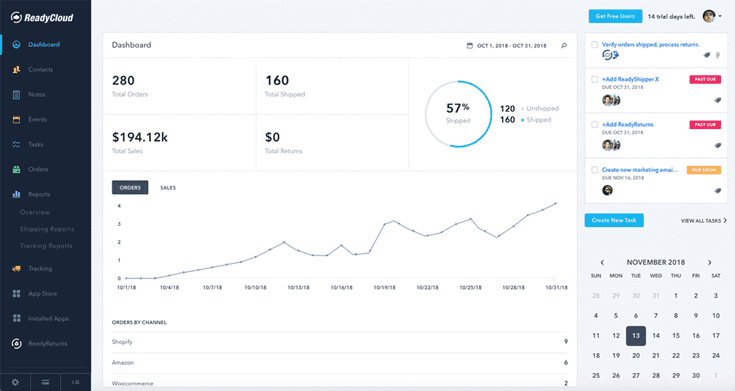
Success in 2026 starts with the right tools, and ReadyCloud’s suite of solutions is designed to propel your ecommerce business to new heights. With ReadyCloud, you’ll have all your data centralized in one place, offering insights that drive smarter decisions. Take your marketing to the next level with Action Alerts, delivering growth-focused, automated campaigns that keep your customers engaged.
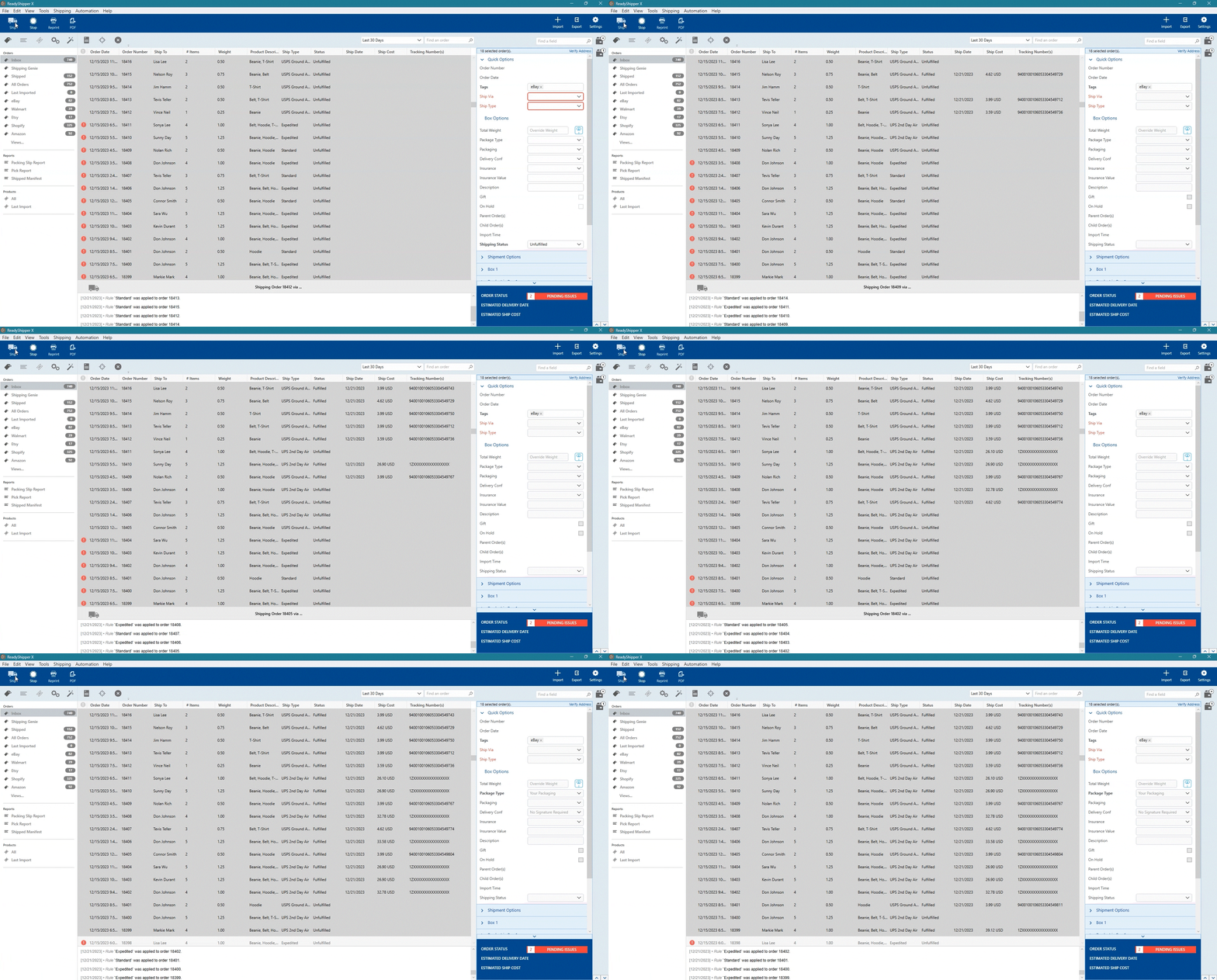
Shipping is easier than ever with ReadyShipper X, a multicarrier solution that simplifies your fulfillment process while saving time and money.
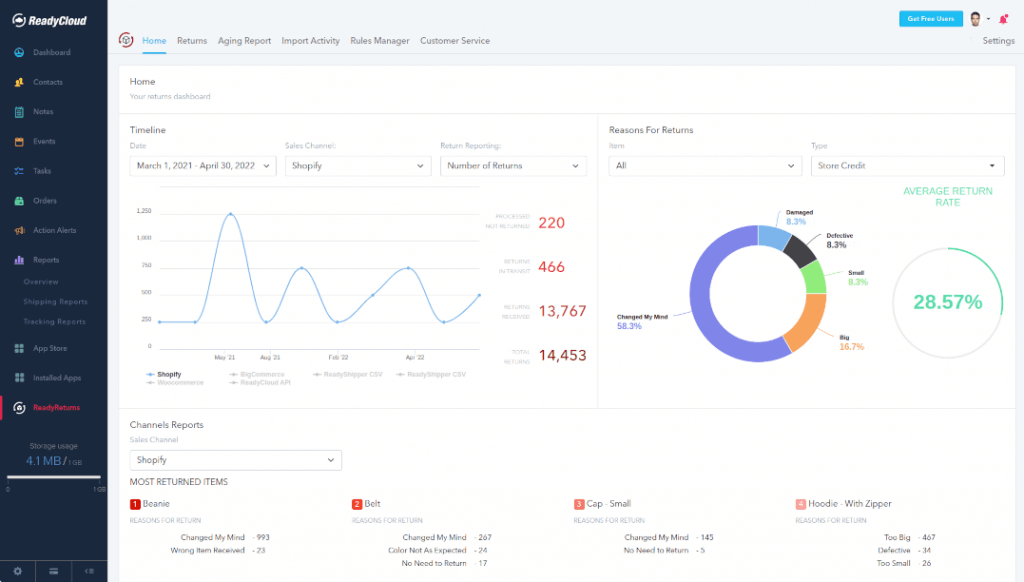
And when it comes to returns, ReadyReturns streamlines the entire process with an automated solution that boosts customer satisfaction and loyalty.
ReadyCloud is more than just a suite of systems—it’s your ticket to thriving in 2025 and beyond!
Start your journey to success today! Learn more and get started here.
Or contact our Sales Department at: 877-818-7447 ext. 1.
Frequently Asked Questions About Product Returns Management Software
What Is Product Returns Management Software?
Product returns management software coordinates the full returns lifecycle, not only labels. It supports customer self-service initiation, eligibility rules, tracking, receiving, inspection, disposition, and resolution paths, such as refunds, exchanges, or store credit. It also centralizes reporting, so return reasons and operational timestamps become decision-making data instead of scattered notes.
How Does Product Returns Management Software Reduce Return Costs?
Cost reduction comes from fewer manual touches and faster cycle times. If your time-to-resolution improves, you typically see fewer refund-status tickets and less support overhead. If warehouse cycle time improves, items restock faster, reducing value loss tied to delays and markdowns. Shipping efficiency is important in 2026, especially given the upward pressure on carrier rates, including USPS rate increases referenced in industry reporting.
What Features Should I Look For In Product Returns Management Software?
Look for a branded self-service portal, configurable policy rules, and real-time status updates that reduce “where’s my refund” contacts. Exchanges and store credit flows should be built in, since retained value is a core KPI in modern returns programs. You’ll also want standardized reason codes and reporting that segment by SKU family, customer cohort, and timestamps so you can spot patterns. Fraud indicators and guardrails are also essential, since return abuse is a meaningful part of the 2026 returns landscape.
How Long Does It Take To Implement Product Returns Management Software?
Implementation time depends on channel complexity, the number of locations, and the clarity of your policy rules today. The fastest rollouts typically start with a pilot scope, defined reason codes, and a clean set of eligibility rules that can be enforced consistently. From there, teams expand routing rules, exchange-first paths, and reporting dashboards once the base workflow is stable. A phased approach keeps operations running while improvements roll out in manageable steps.
Can Product Returns Management Software Handle Marketplace Returns?
Yes, marketplace support is often a key reason brands adopt a dedicated returns platform. Marketplaces can impose strict timelines and verification requirements, and inconsistencies can lead to disputes and rating risk. Centralized visibility, consistent rule enforcement, and defensible tracking are the building blocks of a smoother marketplace returns program.
Does Product Returns Management Software Support Exchanges And Store Credit?
Strong platforms support exchange-first flows and store credit options by helping retain revenue and improve customer satisfaction. This is especially useful in categories such as apparel and footwear, where bracketing and fit issues drive high return rates. Measuring the exchange rate and the store credit selection rate helps you see how often value stays in your ecosystem rather than leaving as a refund. Over time, these options can turn a return moment into a loyalty moment, especially when the flow is self-serve and fast.
How Does Product Returns Management Software Improve Customer Experience?
Customers want clarity and speed, and the data summarized in the ReadyCloud doc highlights expectations for acknowledgment, clear explanations, and real-time updates. A branded portal helps customers initiate returns without contacting support, while proactive status updates reduce anxiety and reduce the need for repeat follow-ups. Faster processing also means faster refunds or exchanges, which is one of the biggest drivers of post-purchase trust. A smoother experience can help protect repeat-purchase behavior, especially during peak season when delays are common.
What Reports Should Product Returns Management Software Provide?
Return rate is useful, yet it’s only the top layer. You also want standardized return reasons, time to resolution, cost per return, warehouse cycle time, and support contacts per return. Fraud indicators and unusual condition patterns should also be tracked, since abuse can materially impact margins. The most useful reporting segments these metrics by category, SKU family, customer cohort, and time period so you can act on the insights instead of staring at averages.
Is Product Returns Management Software Worth It For Mid-Sized Brands?
Mid-sized brands often hit the breakpoint where manual returns work “most days,” then collapse during peak or during channel expansion. Industry forecasts cited in the doc show online return volumes rising, and ecommerce return rates tend to run higher than overall retail, which means the pressure increases as you grow. If your support team is fielding refund-status tickets and your warehouse is struggling with inspection and restock delays, the ROI can show up quickly in labor savings, faster restocks, and better retained value through exchanges and credit. The key is measuring your baseline cost per return and time to resolution so the improvement is visible in real numbers.